|
 |

New Online Courses Available:
Orientation
to the Essentials of Public Health - Introductory Level This course provides a brief history of public health in the US. It also discusses the guiding principles for those who practice public health. From the initial three core functions of public health first defined by the Institute of Medicine in 1988 through the current 10 essential services of public health set by the US Department of Health and Human Services. The expanded role of public health in the times of disasters is also explored. Examples of current public health initiatives in the Southeast as well as testimonials by current public health employees demonstrates the importance of public health in today's society.
Psychological
First Aid: Building Resiliency for "Us" and "Them" The importance of Psychological First Aid for victims of a disaster as well as first responders has been well established. From the attacks of 9/11 to Hurricane Katrina, the mental impact of a disaster often has far reaching and lasting effects. While more attention is being paid to the psychological needs of victims and first responders, the fact remains that often times during an actual crisis, those needs are not addressed or are not emphasized based on the surrounding physical and environmental needs. Promoting an environment of safety, calm, connectedness, self-efficacy, empowerment and hope is the main goal of providing Psychological First Aid. That’s why basic training in the foundations of Psychological First Aid is critical for anyone who may be called to respond in a disaster situation. This program will help you to better recognize and manage the basic symptoms of psychological distress and give you the tools you need to apply basic Psychological First Aid to children, the elderly, and others in general. NOTE: This course was originally presented as a satellite broadcast.
Productive Communication Skills This course is designed to provide you with the communication skills you will need to help you take the next step up in your organization. After taking this course, you will be able to reach a positive outcome with those you supervise by understanding personal communication style differences, using turn-taking effectively, noticing facial expressions which may signal emotions, and maintaining an appropriate body posture when communicating. You will learn the preferred pace of the different styles, and how styles shift under stress. You will learn how to increase your productivity by identifying high payoff activities, handling conflicting priorities, and using your most productive time of day to your advantage. You will learn how to deal with difficult people by improving your listening skills and becoming a more persuasive person.
The challenges of disaster and emergency planning and the coordination of response increase significantly when the event spans state lines, borders of sovereign Tribal nations, and international borders. Challenges associated with cross border response range from technical issues such as the compatibility of communications systems to legal issues such as authority and power of responders to the managerial issues of planning, organizing, and controlling the response. In order to deal with these challenges multi-jurisdictional agreements in the forms of Memorandums of Understanding and Mutual Aid Agreements are often created. While such agreements are essential to developing the details of collaboration, testing the effectiveness in terms of both substance and form through drills and exercises is necessary and offers additional benefits of strengthening relationships and building confidence among cross-border response organizations. NOTE: This course was originally presented as a satellite broadcast.
Special Needs
Populations in Disaster Response The discussion will assist in identifying vulnerable populations in a community at risk and assess significant requirements and challenges inherent in their time-phased emergency support. It will examine the tools required for lifesaving as well as those needed for broader consequence management which can be confidently employed. It will also discuss the most effective manners of use for these tools.
Upcoming Satellite Broadcast:
Responding to
Victims with Burn Injuries in Disaster Events
12:00 - 1:30 p.m. (Central Time) According to United States Fire Administration 2007 data, fire killed more Americans than all natural disasters combined. Approximately 10,000 people in the United States die every year because of infections that complicate burns. In an effort to contribute to improved response and overall outcomes for victims of fires, the University of Alabama at Birmingham and Tulane’s South Central Center for Public Health Preparedness is partnering with the Alabama Department of Public Health to host a live satellite broadcast on burn evaluation and care for emergency responders. This satellite will feature Dr. Ziad Kazzi of Emory University’s Department of Emergency Medicine and Dr. James Cross of the University of Alabama at Birmingham’s Burn Center. While burn injuries are common in the United States, specialized burn centers often lack the capability to care for large numbers of burn victims. For this reason, improved initial evaluation, triage and management of burn injuries can significantly impact victim outcomes. These tasks are most commonly performed by emergency responders and first receivers (paramedics, nurses and physicians). This broadcast will raise the overall burn care expertise among participants and prepare these individuals to respond to public health threats and burn-related emergencies.
Other Training Opportunities: Fourth Public Health Certificate Program Has Launched
The
South Central Public Health Partnership (SCPHP) is pleased to
announce the launch of its fourth online certificate program in
public health. The SCPHP certificate program provides a certificate
of completion upon completion of all courses in a particular subject
or focus area. The fourth series in the SCPHP certificate program is
Leadership Communication. There are 5 courses required for this
program. On completion of the Leadership Communication Certificate
Program, you will be able to demonstrate written and oral
communication skills that are needed as a leader or manager in the
public health setting. No matter how effective a leader or
manager you already are, this program is designed to refresh and
refine the communication skills needed to succeed in today's
fast-paced and stressful public health environment. Issues
that are covered in the certificate program include:
negotiation, conflict resolution, writing techniques, presentation
skills, indirect communication styles such as facial expressions and
body postures, and the use of media in times of disaster. Course titles will be shown once you enroll to the certificate
program. The Partnership is excited about this newest addition to
our online training programs. For more information on how to
register for the new certificate program, go to the
user manual Preparedness Minute Videos Preparedness Minutes are video clips describing actions to take in emergency situations, whether they are at work or at home. Some of the videos will be reminders, others will present new information. Ultimately these videos will help you be prepared for an emergency or disaster. Please visit the link below to watch any of our preparedness minute videos. New Preparedness Minute Videos by Dr. Joshua Klapow, Associate Professor, Department of Health Care Organization and Policy, University of Alabama at Birmingham
Disaster Management Program A new program in Disaster Management is being offered by Tulane School of Public Health and Tropical Medicine, Department of Environmental Health Sciences. This program is offered both on campus and by distance learning through the Center for Applied Environmental Public Health (CAEPH). Students may obtain either a graduate certificate or the full MPH in disaster management. The Tulane CAEPH distance learning programs are geared to mid career professionals. CAEPH uses state-of-the-art synchronous distance learning technologies to enhance learning and networking. For more information, contact Albert Terrillion at DLinfo@tulane.edu or at 1-800-862-2122. UCLA Center for Public Health and Disasters Presents: 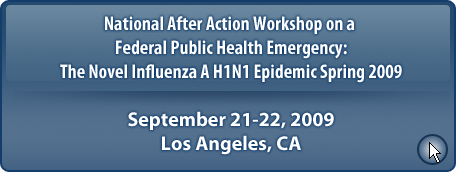 What: Leaders from the Centers for Disease Control and Prevention, and state and local health departments have committed to participate in this national dialogue that will give participants the unique opportunity to interact with colleagues from all levels of the response, and to participate in working sessions to identify gaps to be addressed as we enter the fall influenza season. When: September 21-22, 2009 Where: Torrance Marriott Hotel, 3635 Fashion Way, Torrance, CA 90503 For more information including the agenda, fees, and registration please visit their site: http://www.cphd.ucla.edu Partner Update: University of Alabama at Birmingham and the South Central Center for Public Health Preparedness Exercise for a Closed Point of Distribution (POD) On May 19th, 2009, the South Central Center for Public Health Preparedness (SCCPHP) in conjunction with the University of Alabama at Birmingham (UAB) and the Alabama Department of Public Health (ADPH) conducted a full-scale preparedness exercise to practice the opening and operations of a closed point of dispensing (POD) site at Bartow Arena on the UAB campus. A POD is a temporary clinic that is activated during a public health emergency to distribute vaccines or other medications to a large population in a short amount of time. A closed POD would serve a specific population, in this case, the faculty, staff, and students of UAB. To ensure safe, effective, and efficient operations of any POD site, detailed plans need to be developed and practiced. Exercises, such as this one, are needed to identify potential areas of improvement and to rehearse POD operations. It is important for public health professionals and the staff and volunteers who will manage and occupy POD operations to set up the POD and carry out the dispensing operations prior to an actual public health emergency. In the UAB exercise scenario, an unknown white powder was dispersed on the UAB campus and identified to be anthrax (B. anthracis) by the Alabama Public Health Laboratory. A public health emergency was declared by the Alabama Department of Public Health. Supplies were requested and received from the Strategic National Stockpile (SNS) to provide prophylaxis via the activated closed POD at Bartow Arena to those potentially exposed. During the exercise, volunteer actors reported to the POD with scripts to test the ability of the POD staff to successfully administer appropriate prophylaxis to the affected individuals and to identify difficulties in the process. During the exercise, POD staff quickly and successfully processed a large number of individuals from a wide range of ages and medical histories and with a variety of pre-existing health conditions and contradictory medications. In the after exercise discussion (“hot wash”), participants identified the need for specific task lists for individuals staffing the POD. These lists would detail their duties and proper procedures for complicated circumstances (i.e. unaccompanied minors). A different POD layout was proposed as well as the placement of colored tape on the ground so that patients can be direct easily to the next appropriate station within the POD. Finally, the POD exercise exemplified the need to explore HIPAA regulations during emergency POD settings.
Other Online Courses Available:
Continuity of
Operations Planning
Mass Casualty
Medical Command
Quick Links: Register
Now!
|
|
Participants have 7 weeks to complete each course. A certificate of completion is awarded to those who score 70% or better on the knowledge-based assessment. All courses are FREE. Sponsored by a grant from the Centers for Disease Control and Prevention. This email was sent to you because you have participated in a training offered by the South Central Public Health Partnership. These projects are supported under a cooperative agreement from the Centers for Disease Control and Prevention (CDC) grant number U90/CCU624254-02, and the Department of Health and Human Services Health Resources Administration (HRSA) grant number D20HP00012-07. The contents of this program are solely the responsibility of the authors and do not necessarily represent the official views of the CDC. |