|
 |

Upcoming Satellite Broadcast:
Alternative Standards of Care in Disasters 12:00 - 1:30 p.m. (Central Time) Emergency events require a population to adapt quickly to changing circumstances including an often limited scope of public health services. In such instances, alternative standards of care allow medical personnel to streamline and simplify the support process to preserve lives. Planning for emergencies requires incorporating alternative standards into the public health system, which involves utilizing the best combination of current technology and available resources to create a robust and reliable outcome. Prevention based management and broad based community planning across the wide range of interests and potentially responding agencies, is a critical step in establishing the plans and preparation needed to effectively execute alternative standards of care. This program will examine these issues in the context of the principle priority for American consequence management in disaster, the preservation of human life.
Upcoming Workshop:
Burn
Evaluation and Care for Emergency Responders Course Lincoln, AL - Friday, March 13, 2009 Huntsville, AL - Monday, March 16, 2009 *For registration and a full list of dates and locations please click here This 8 hour course is intended for first responders and receivers including firefighters, emergency medical personnel, and nurses who would be the first to treat burn victims. The Burn Evaluation and Care for Emergency Responders Course, adapted from the American Burn Association materials and trainings, introduces information relevant to the care of casualties from burn injuries. For more information please contact Michael Poole at the UAB School of Public Health (Phone: (205) 934-7735; Email: mepoole@uab.edu)
New Online Courses Available: Productive Communication Skills
Special Needs
Populations in Disaster Response The discussion will assist in identifying vulnerable populations in a community at risk and assess significant requirements and challenges inherent in their time-phased emergency support. It will examine the tools required for lifesaving as well as those needed for broader consequence management which can be confidently employed. It will also discuss the most effective manners of use for these tools.
Two Years
Later: Continued Psychological Difficulties of First Responders and the Affected
General Population
Understanding
and Responding to the Needs of Children After Large-Scale Disasters Disasters can leave children feeling frightened, confused, and insecure. Whether a child has personally experienced trauma, has merely seen the event on television, or has heard it discussed by adults, it is important that healthcare professionals be informed and ready to help if reactions to stress begin to occur. Children may respond to disasters by demonstrating fears, sadness, or behavioral problems. Younger children may return to earlier behavior patterns, such as bedwetting, sleep problems, and separation anxiety. Older children may also display anger, aggression, school problems, or withdrawal. Some children who have only indirect contact with the disaster but witness it on television may develop distress. This course will describe how children may respond to traumatic events, with a focus on CBRNE incidents. Ideas for interventions, including a new model of Psychological First Aid will be presented. Finally, recommendations for preparation considerations will be explored. NOTE: This course was originally delivered as a satellite broadcast.
Workshop In-Depth:
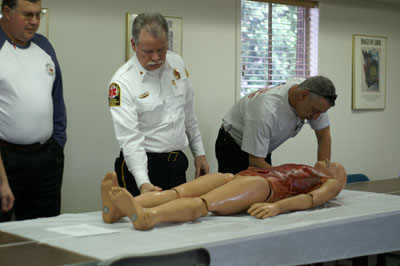
According to United States Fire Administration 2007 data, fire killed more Americans than all natural disasters combined. Approximately 10,000 people in the United States die every year because of infections that complicate burns. In an effort to contribute to improved response and overall outcomes for victims of fires, the University of Alabama at Birmingham's South Central Center for Public health Preparedness is providing 6 Burn Evaluation and Care for Emergency Responders courses in the state of Alabama in 2009. Developed by Dr. Ziad Kazzi of Emory University's Department of Emergency Medicine and Dr. James Cross of the University of Alabama at Birmingham's Burn Center, this one-day course introduces information relevant to the care of casualties from burn injuries. While burn injuries are common in the United States, specialized burn centers often lack the capability to care for large numbers of burn victims. For this reason, improved initial evaluation, triage and management of burn injuries can significantly impact victim outcomes. These tasks are most commonly performed by emergency responders and first receivers (paramedics, nurses and physicians). This course will raise the overall burn care expertise among participants and prepare these individuals to respond to public health threats and burn related emergencies. Material covers burns sustained from exposure to electrical current, caustic chemicals, sulfur mustard and radiological sources. Also included is a table top exercise that involves a practical session in which participants evaluate and design a management plan for a mannequin accompanied by a clinical scenario. There are two courses scheduled for March 2009. Registration is accessible from the link under Upcoming Workshops.
Other Training Opportunities: Preparedness Minute Video Preparedness Minutes are video clips describing actions to take in emergency situations, whether they are at work or at home. Some of the videos will be reminders, others will present new information. Ultimately these videos will help you be prepared for an emergency or disaster. Below is the link to our latest clip on administering psychological first aid. Third Public Health Certificate Program Has Launched
The
South Central Public Health Partnership (SCPHP) is pleased to
announce the launch of its third online certificate program in
public health. The SCPHP certificate program provides a certificate
of completion upon completion of all courses in a particular subject
or focus area. The third series in the SCPHP certificate program is
Bioterrorism Preparedness. There are 5 courses required for this
program. This certificate program includes courses that provide
training in bioterrorism preparedness and understanding the public
health threat. Emergency providers that will be responding to
bioterrorism events are also one of the focuses of this program.
Course titles will be shown once you enroll to the certificate
program. The Partnership is excited about this newest addition to
our online training programs. For more information on how to
register for the new certificate program, go to the
user manual Disaster Management Program A new program in Disaster Management is being offered by Tulane School of Public Health and Tropical Medicine, Department of Environmental Health Sciences. This program is offered both on campus and by distance learning through the Center for Applied Environmental Public Health (CAEPH). Students may obtain either a graduate certificate or the full MPH in disaster management. The Tulane CAEPH distance learning programs are geared to mid career professionals. CAEPH uses state-of-the-art synchronous distance learning technologies to enhance learning and networking. For more information, contact Albert Terrillion at DLinfo@tulane.edu or at 1-800-862-2122. Other Online Courses Available:
Continuity of
Operations Planning
Mass Casualty
Medical Command
Quick Links: Register
Now!
|
|
Participants have 7 weeks to complete each course. A certificate of completion is awarded to those who score 70% or better on the knowledge-based assessment. All courses are FREE. Sponsored by a grant from the Centers for Disease Control and Prevention. This email was sent to you because you have participated in a training offered by the South Central Public Health Partnership. These projects are supported under a cooperative agreement from the Centers for Disease Control and Prevention (CDC) grant number U90/CCU624254-02, and the Department of Health and Human Services Health Resources Administration (HRSA) grant number D20HP00012-07. The contents of this program are solely the responsibility of the authors and do not necessarily represent the official views of the CDC. |